
“Where are you living this semester?” Among all the questions new and returning college students are sure to volley at one another, this one might seem as harmless as “what did you do for summer break?” However, the answer reveals a hidden reality for college students across the country––campus housing situations play a significant role in segregating students.
Although luxury residence halls and campus housing policies like differentiated pricing help institutions recruit prospective students, my research shows that these practices have unintended consequences for student equity and even classroom performance.
The big business of student housing
Over the past two decades, American colleges and universities, grappling with heightened competition, have sought innovative ways to boost profits in a tightening enrollment market. Many schools pursued a strategy of investing in campus infrastructure––especially new residence halls––in order to attract prospective students. Most colleges and universities rely on tuition dollars to fund their operations, and schools looking to “sell” themselves in a competitive market of student “shoppers” have often turned to student housing to generate financial margins.
Colleges and universities that succeeded in luring students with housing went further, introducing differentiated pricing models that charged higher rates for amenity-filled halls and lower rates for more modest facilities or “triples.”
The model creates a price “gap” between the most expensive and least expensive areas of a university campus. The table below shows a sample of institutions and the housing price gap created by their differentiated pricing models. The difference between the highest and lowest priced residence halls at some universities remains small, like those at the University of Nevada, Las Vegas ($1,160), the University of Virginia ($1,490), and the University of North Texas ($1,690). In contrast, the high-low price gap at other universities is a chasm: the difference between the most affordable and most expensive dorm rooms at the University of Miami is $14,220; at NYU and Old Dominion University, more than $15,400; and at Marymount University, a whopping $17,400.
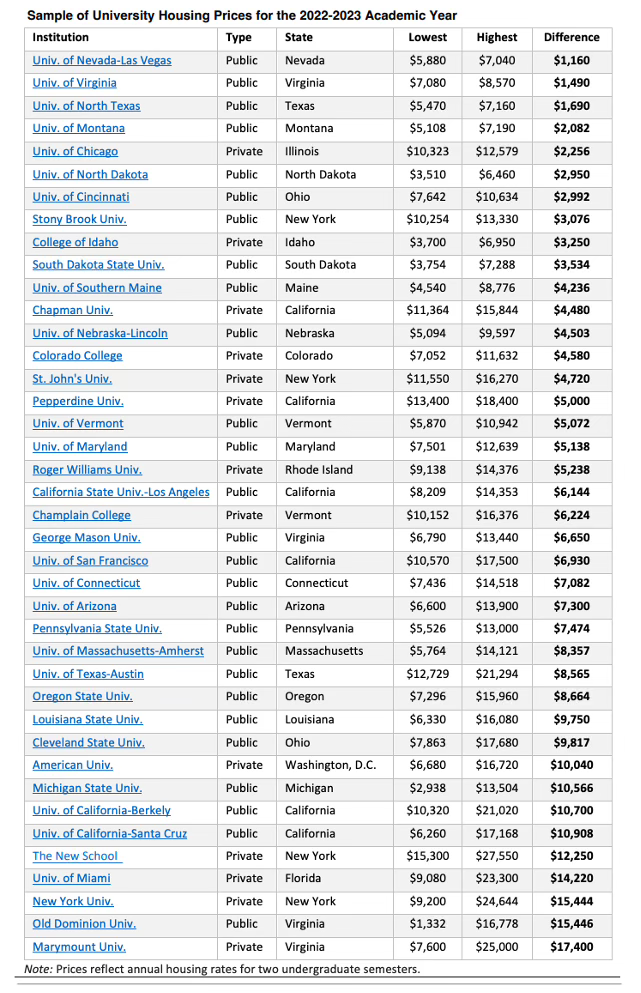
In effect, some institutions have created “neighborhoods” on university campuses separated by wealth. This practice resembles the segregated socio-economic layout of many American cities, where the wealthy cluster in one area of town and those of lesser financial means live “on the other side of the tracks.”
Does luxury housing and the price gaps in residence hall housing shape student experience and academic performance? I assembled a research team funded by the Association of College and University Housing Officers-International (ACUHO-I) to tackle this question. What we discovered after two years of data collection should concern administrators and students alike. Universities became so focused on attracting students through admissions that they overlooked how housing policies would affect those same students once enrolled.
From financial margins to social margins
Our work yielded three primary takeaways. First, in our study, differentiated pricing and housing options segregated students by income. The data in the table below (circled in red) show three types of student housing options on a campus – corridor, suite (apartment), and luxury. The red circles show the clear difference in mean Federal Expected Family Contribution (EFC) levels between residents in luxury housing and those living in the cheaper “suite” facilities. Unsurprisingly, those able to afford luxury housing had parents who were expected to pay more for their child’s education – presumably because they were wealthier than those parents whose children were living in suites.
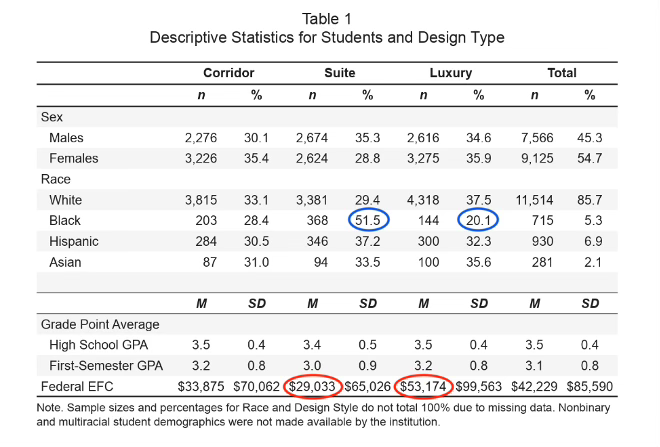
But the differentiated pricing and housing options didn’t just segregate students based on wealth. We also found they segregated students by race. While we found a generally average distribution based on enrolled student race classifications in the “corridor” style housing (which correlated to a slightly higher expected Federal EFC than for those in suite housing), Black students were significantly overrepresented in suite-style housing and underrepresented in luxury housing (above, circled in blue). In our study, corridor residence halls were those with rooms on either side of a long corridor with shared restrooms.
Finally, we also found that the pricing gap reduced opportunities for all students in luxury halls to engage with their Black peers. Research shows that cross-racial peer interaction enhances academic engagement, cultural understanding, and long-term outcomes for white students as well as students of color. The stratifying effects of student housing policies between residence halls suggest consequences for everyone, as we explained in our report:
Not only do Black students in luxury halls have fewer opportunities to encounter peers of the same race, but all students in the luxury halls have fewer opportunities to encounter their Black peers, potentially negatively influencing their academic outcomes.
The results of our research, when considered as a whole, indicate that the combination of luxury-style residence halls and differentiated pricing may further marginalize students both socially and academically.
The call is coming from inside
As a society, we have focused our attention on equalizing the policies at the entry gates of college while often overlooking policies inside the institution that shape daily life. This omission includes examining where people live and how they might group together in ways that conflict with the educational mission of the institution (a challenge facing countless schools that I cover more extensively in my book Capitalizing on College: How Higher Education Went from Mission Driven to Margin Obsessed).
Our higher education system already allows the wealthy to segregate themselves by attending elite institutions. But as our research shows, we have also developed structures that enable the wealthy to segregate themselves from others within individual institutions. Building high-end residence halls and differentiated pricing can also build environments of difference that seemingly privilege the wealthy on any campus but actually harm everyone, including wealthy students. This is just one example of how financial policies inside the gates can shape student life, with far-reaching consequences that demand critical scrutiny.

Further Reading:
There are many voices covering important issues surrounding student housing in America. I invite you to check them out to keep the conversation going.
Kudos to my friend Scott Carlson, who will be partnering with Adam Bush and College Unbound to moderate a discussion about college life and student housing, including an interview with Juan Salgado, chancellor of the City Colleges of Chicago. The event will be held at Chicago’s National Public Housing Museum on Friday, September 5 and you can RSVP here.
Even if you’re not able to make it, be sure to check out Scott’s Chronicle of Higher Education column where he often covers topics surrounding student housing, like this interview with author Seth Kaplan on the importance of community.
Ryan M Allen, whose Substack College Towns I have had the honor of guest writing for, has brought attention to numerous challenges facing colleges and universities today, including the marketization of student housing:
“Every week, I see companies trading multimillion-dollar student housing real estate in college towns across the world like Pokémon cards. For instance, Campus Advantage promises investors huge returns on their student housing portfolio due to growth and unmet demand. They stated, ‘annual sales volume increasing over 200% in a five-year period from approximately $2.95 billion in rolling average in 2013-2014 to $6.12 billion rolling average in 2018-2019.’”
“When student housing is treated primarily as a vehicle for financial return—or even as a symbol of global mobility—it becomes detached from the academic mission it is meant to support.” These words of caution from Shanshan Jiang-Brittan, editor & external relations specialist at the Center for Studies in Higher Education, UC Berkeley, serve as a poignant reminder for those of us working toward equity in higher education.
Ken Budd, author and former editor-in-chief of the Council for Advancement and Support of Education’s Currents Magazine shines a light on “The Campus Housing Crisis” in his piece for the AAC&U.
Dave Deek has looked at the economic realities facing many college campuses around the country, and creative building repurposing ideas for those that don’t make it.
Friend and collaborator Chris R. Glass offers invaluable insights into housing issues facing international students in his latest post on the HALO factors (housing, affordability, labor, and openness) of student mobility, read it here.
Thank you for the mention and for your insightful post! I especially appreciate your analysis on the class and racial division in college housing. Also wanted to point out that ACUHO reports were very helpful for my research.
Always great work here! And thanks for the shout out.